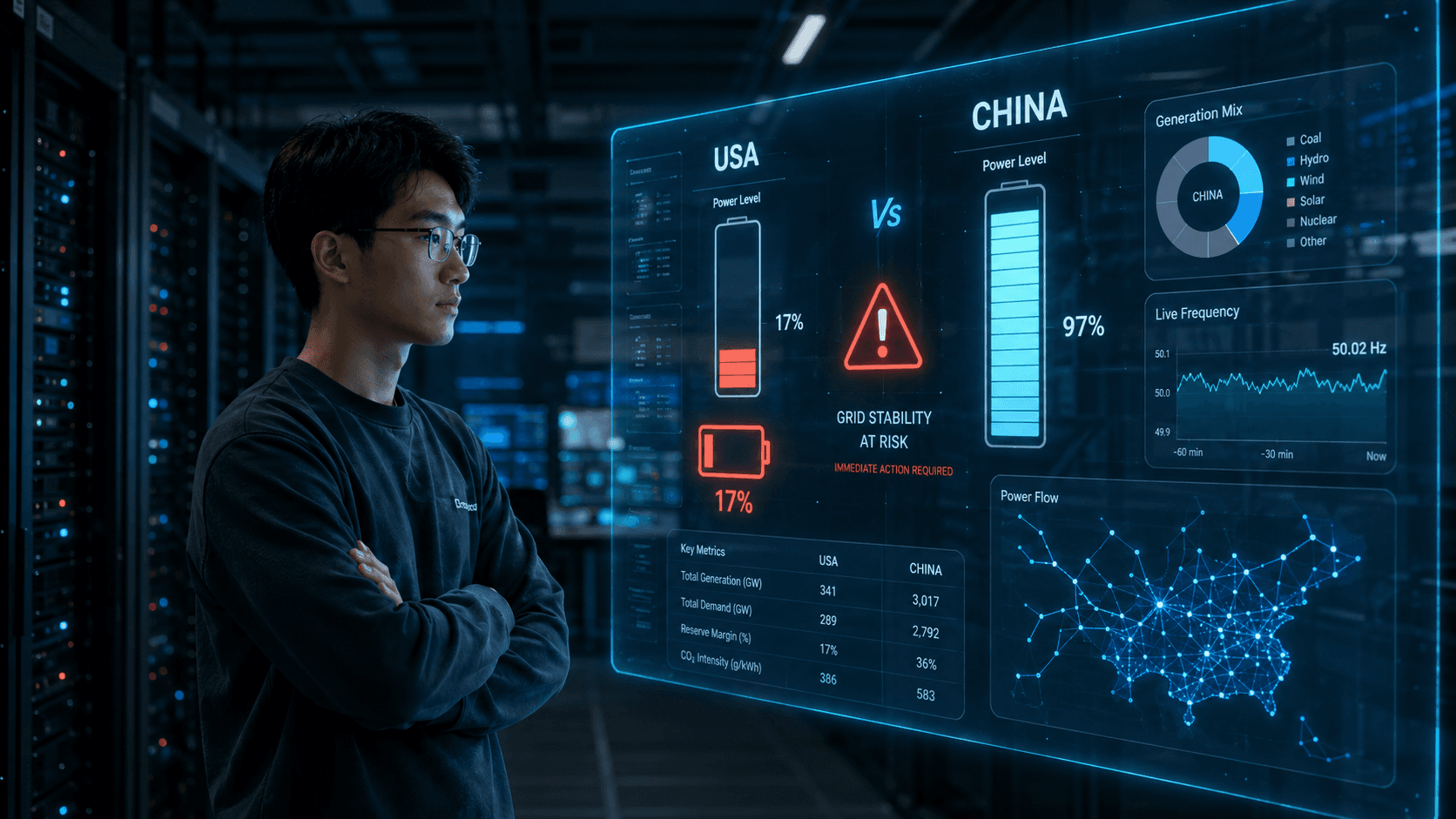
AI is booming both in US and China... Wait a second, is the battery level enough?

AI is booming on both sides of the Pacific. But beneath the race over chips, models, and talent sits a quieter variable—the one your phone nags you about every night: electricity. Before we crown a winner, it is worth asking whether the battery level is even high enough.
Artificial intelligence is having its defining moment. In the United States, hyperscalers are racing to build ever-larger data centers. In China, a wave of home-grown models and chips is closing the gap quickly. From the outside, it looks like a two-horse race about algorithms, researchers, and silicon. Underneath all of it, however, sits a more basic question: who can keep supplying the power?
Data centers run on power—and lots of it
Modern AI is astonishingly power-hungry. Training a single frontier model such as GPT-4 reportedly consumed more than 50 gigawatt-hours of electricity—enough to power thousands of homes for a year. And training is only the beginning. Once a model is deployed, every query, generated image, and chatbot reply draws from the grid around the clock.
The Stanford Review projects that by 2028, AI could consume electricity equivalent to powering 22% of all U.S. households annually. The exact forecast will change as models and hardware become more efficient, but the direction is clear. The bottleneck for AI, increasingly, is not only talent or compute. It is watts.
In the U.S., the grid is pushing back
This is where the American story gets complicated. Across the United States, communities are opposing some new data-center projects. The reason is straightforward and very human: a large facility next door can put pressure on local electricity supplies and potentially raise bills for everyone else. When one site can draw as much power as a small city, residents naturally ask who will pay for the added strain on the grid.
That local friction becomes a national constraint. New power plants, transmission lines, and substations are slow, expensive, and politically contested to build. The Stanford Review notes that the United States has completed only two nuclear reactors since 2014, while its solar manufacturing capacity is around 26 gigawatts. In an AI race measured in gigawatts, that is a tight budget.
In China, the battery is much bigger
China faces less of this particular constraint because its electricity system is much larger. Today, China generates roughly twice as much electricity as the United States. According to Voronoi's analysis, China produced more than 10,000 terawatt-hours in 2024—more than the U.S., the European Union, and India combined.
That is not a rounding-error lead; it is a structural one. China is also continuing to expand. The Stanford Review counts 32 nuclear reactors under development in China, while the United States completed two in the past decade. China's solar manufacturing capacity exceeds 1,000 gigawatts, nearly 40 times the U.S. figure cited in the article.
China also has a strong position in the supply chain that builds the grid itself, including solar wafers, inverters, and specialized materials used in energy infrastructure. Generation capacity matters, but so does the ability to manufacture and deploy the equipment needed to turn that capacity into usable power.
While everyone watches the chips and the benchmarks, the real race may be decided at the substation.
Energy supremacy as an AI advantage
The Stanford Review's core argument is pointed: China's energy advantage could threaten U.S. AI leadership. If energy—not chips or researchers—becomes the binding constraint, then the side that can power more data centers, more cheaply, has room to train and serve more models.
China's centralized approach allows electricity to be treated as strategic infrastructure. Professor Shanjun Li describes a system that layers industrial support across an industry's life cycle, including research-and-development subsidies, operational subsidies, and consumer rebates. The goal is to drive costs down through scale and learning-by-doing.
The U.S., historically cautious about industrial policy, is beginning to respond in its own way. Washington has shown increasing interest in critical minerals, domestic manufacturing, and direct support for strategic industries. That shift suggests energy and materials are being treated less like ordinary market inputs and more like national-security assets.
So—will China overtake the U.S. in AI?
Here is the honest answer: energy is necessary, but it is not sufficient. Raw generation capacity is a genuine and growing Chinese advantage, and it removes a ceiling that the United States is beginning to feel. If the AI race comes down to who can keep the lights on in the server hall, China is holding the bigger battery.
But AI leadership is a bundle of advantages. Cutting-edge chips—where the U.S. and its allies still lead—model quality, software ecosystems, capital markets, and talent all matter. Export controls, efficiency gains, and smarter grid management could also narrow the energy gap. Efficiency is its own frontier: a model that does more work per watt changes the entire calculation.
The takeaway is not that China has already won. It is that the AI conversation may be having the wrong argument. Both nations are booming, but only one has quietly checked the battery level. Right now, that indicator is flashing on the American dashboard.
Sources
- Voronoi: China Generated More Electricity in 2024 Than the U.S., EU & India Combined
- Stanford Review: How China's Energy Supremacy Threatens U.S. AI Dominance
The electricity figures and projections in this post come from the sources above. The approximate U.S. generation comparison should be checked against a primary source such as the U.S. Energy Information Administration before formal publication.
Tom Wang
Master's Student, Northeastern University
MS ECE concentrated in Computer Vision, Machine Learning, and Algorithms, Graduate Student from Northeastern University, Boston. Have a strong interest in software development, Artificial Intelligence/Machine Learning research, and algorithm studies. Participated in related projects and internships such as data analysis using ML methods, machine learning driven algorithms, large model deployment & fine-tuning and multimodal content defense research.

Max Li
Founder, Grassrootech
max@grassrootech.comMax is dedicated to bridging the gap between advanced research and practical industry application. Drawing on his experience at IBM Research and Union University, he leads the development of AI solutions that drive meaningful progress.
Read More
What Should You Do If You Have Used Up Your Quota for OpenAI Codex?
OpenAI Codex is excellent, but quota limits are real. Here is a practical fallback strategy for developers who want to keep building without jumping immediately to a more expensive plan.
Have you heard of OPC: One Person Company?
AI is making a new kind of company imaginable: one person coordinating agents, software, and distribution with the leverage of a much larger team.