Do I Push AI Too Much?

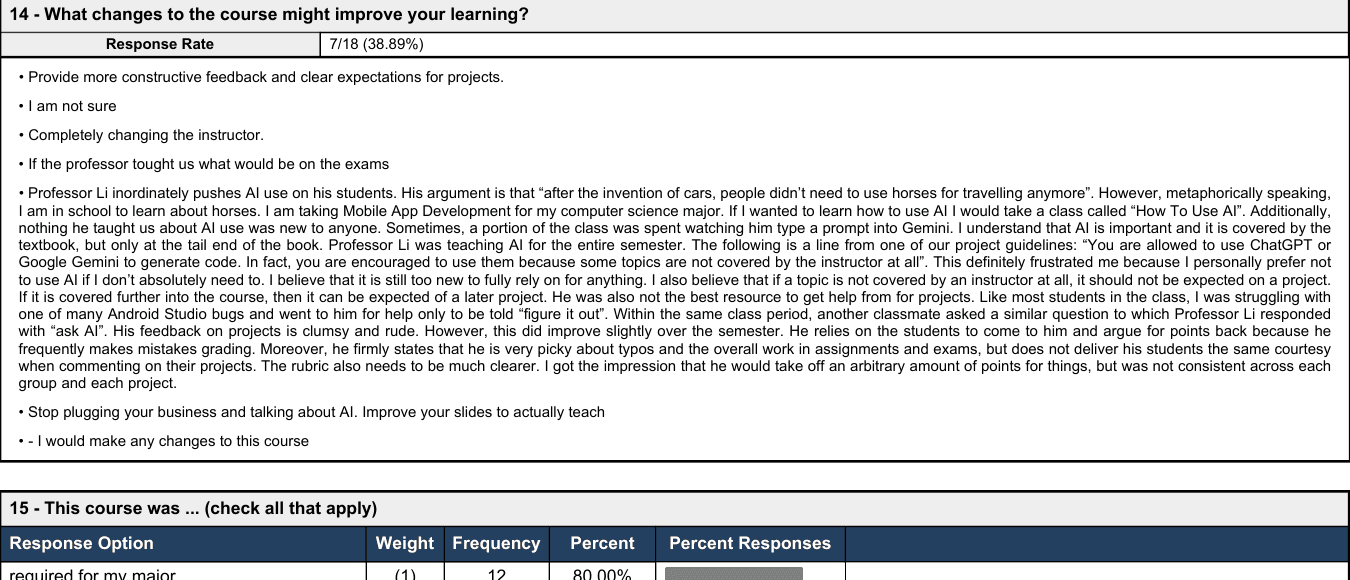
In my recent Mobile Application Development course evaluation, one student wrote that I push AI too much.
I take student feedback seriously. I really do. Teaching is not a one-way performance. If students feel confused, frustrated, or unsupported, a professor should listen. Some parts of the evaluation are useful to me. I can make project expectations clearer. I can improve rubrics. I can make feedback more constructive. I can make sure students know where assignments are and what I expect from them.
But on the question of whether I introduced too much AI into a computer science classroom, I respectfully disagree. In fact, I believe the opposite is true.
Most professors are not paying enough attention to AI's impact on college teaching.
The Criticism
The student's criticism was direct. The student said I pushed AI use inordinately. The student also used my own analogy against me. I had said that after cars were invented, people did not need to use horses for travel in the same way anymore. The student replied, in effect, that they were in school to learn about horses. They signed up for Mobile Application Development, not a course called "How To Use AI."
I understand that feeling. A student pays tuition, takes a required course, and expects to learn the official subject. If the course is mobile app development, the student expects mobile app development. That is fair.
But here is my answer: in 2026, mobile app development is already being changed by AI. It is not a separate subject sitting politely at the end of the textbook. It is becoming part of how software is designed, written, debugged, explained, tested, and maintained.
So if I teach mobile app development as if AI does not exist, I may make the course feel more traditional, but I would make it less honest.
The Horse Analogy Still Matters
The horse analogy is not perfect. No analogy is perfect. But the point is still important.
When cars became common, learning about horses did not become useless. Some people still needed horses. Some people loved horses. Some people built careers around horses. But transportation as a field changed forever. A teacher who kept teaching travel as if cars were a temporary distraction would not be protecting students. That teacher would be hiding the world from them.
The same is happening in software development. Students still need fundamentals. They need to understand variables, functions, data structures, user interfaces, APIs, debugging, architecture, and good taste in design. AI does not remove the need for these things.
But AI changes the environment in which those fundamentals are used. A student who knows syntax but does not know how to work with AI will be at a disadvantage. A student who blindly trusts AI without understanding the fundamentals will also be at a disadvantage. The right answer is not anti-AI or AI-only. The right answer is AI plus judgment.
AI should not replace learning. AI should make the need for real learning more visible.
Why AI Belongs in the Classroom
Some students think AI is too new to rely on. I agree with part of that concern. AI makes mistakes. AI can hallucinate. AI can produce code that looks confident and fails quietly. AI can make a weak student look stronger for one assignment while leaving the student with less understanding.
That is exactly why AI belongs in the classroom.
If AI is powerful and imperfect, students need guided practice with it. They need to see when it helps and when it fails. They need to learn how to ask better questions, how to verify generated code, how to compare answers, how to read documentation, how to debug AI output, and how to take responsibility for the final result.
Pretending that students will not use AI is unrealistic. Punishing every AI use is also not enough. A better classroom teaches students how to use AI honestly, carefully, and professionally.
In a programming course, "ask AI" should not mean "stop thinking." It should mean: ask, test, inspect, revise, and explain. The student still owns the work. The student still needs to understand the code. The student still needs to answer for the design decisions. AI is a tool, not an excuse.
The Evaluation Was Not One Story
The course evaluation was mixed, not one-sided. The response rate was high: 15 out of 18 students responded. Some feedback was painful to read. Some feedback was encouraging.
For example, the evaluation showed strong numbers for participation. Students rated the statement that I invited questions and participation at 4.53 out of 5. The assignments were rated 4.00 out of 5 for developing understanding. The course developed skills related to the subject matter at 3.80 out of 5.
In the open comments, one student wrote that the hands-on projects and in-class practice worked well. Another wrote that I was passionate about computer science and interested in student project topics. Another wrote that I was engaging, funny, nice, understanding, fair, and good at making complicated topics digestible.
I am not using those positive comments to erase the negative ones. That would be too easy. But I also should not let one criticism define the whole course, especially when that criticism attacks the very thing I believe is necessary for modern computer science education.
Where I Can Improve
Defending AI in the classroom does not mean defending every teaching choice I made. I can improve the course.
I should be clearer about what students must learn without AI and what they may use AI to explore. I should explain the purpose of AI demonstrations more explicitly. If I show a prompt in Gemini or ChatGPT, I should connect it directly to the learning objective of the day. I should make rubrics more detailed so students do not feel that grading is arbitrary.
I also need to be careful with the sentence "ask AI." I believe students should ask AI. But as a teacher, I should often add the next sentence: after AI answers, bring the answer back, test it, and let us examine it together. That is where the learning happens.
So yes, there are things I can do better. A professor should never hide behind a big idea to avoid small improvements. But the big idea is still right.
The Larger Problem
The larger problem in higher education is not that a few professors are pushing AI too much. The larger problem is that many institutions are still trying to decide whether AI belongs in the classroom at all.
AI is already in the workplace. It is already in software development. It is already in writing, research, design, marketing, customer service, data analysis, and administration. Students will graduate into that world whether we prepare them or not.
If colleges treat AI only as a cheating problem, we miss the deeper educational problem. The question is not only, "How do we stop students from misusing AI?" The better question is, "How do we teach students to use AI with knowledge, ethics, discipline, and responsibility?"
That is why I introduce AI to my classroom. Not because AI is fashionable. Not because I want to promote a business. Not because I think fundamentals no longer matter. I introduce AI because the world my students are entering has changed.
My Answer
So, do I push AI too much?
My answer is no.
I may need to teach AI better. I may need to frame it better. I may need to connect it more clearly to each assignment and each learning goal. Those are fair challenges, and I accept them.
But I do not accept the idea that AI should stay at the tail end of the textbook while the real course happens somewhere else. AI is now part of the real course. It is part of programming. It is part of professional life. It is part of the future our students are already walking into.
My job is not to preserve a classroom untouched by the present. My job is to help students become capable in the world as it is becoming.

Max Li
Founder, Grassrootech
max@grassrootech.comMax is dedicated to bridging the gap between advanced research and practical industry application. Drawing on his experience at IBM Research and Union University, he leads the development of AI solutions that drive meaningful progress.
Read More

What Should You Do If You Have Used Up Your Quota for OpenAI Codex?
OpenAI Codex is excellent, but quota limits are real. Here is a practical fallback strategy for developers who want to keep building without jumping immediately to a more expensive plan.

Have you heard of OPC: One Person Company?
AI is making a new kind of company imaginable: one person coordinating agents, software, and distribution with the leverage of a much larger team.