No One Registered, But I Went Anyway

Yesterday, May 21, 2026, I gave a talk at the Andover Senior Center. The title was "OpenAI as an Example of Autonomous AI Agent."
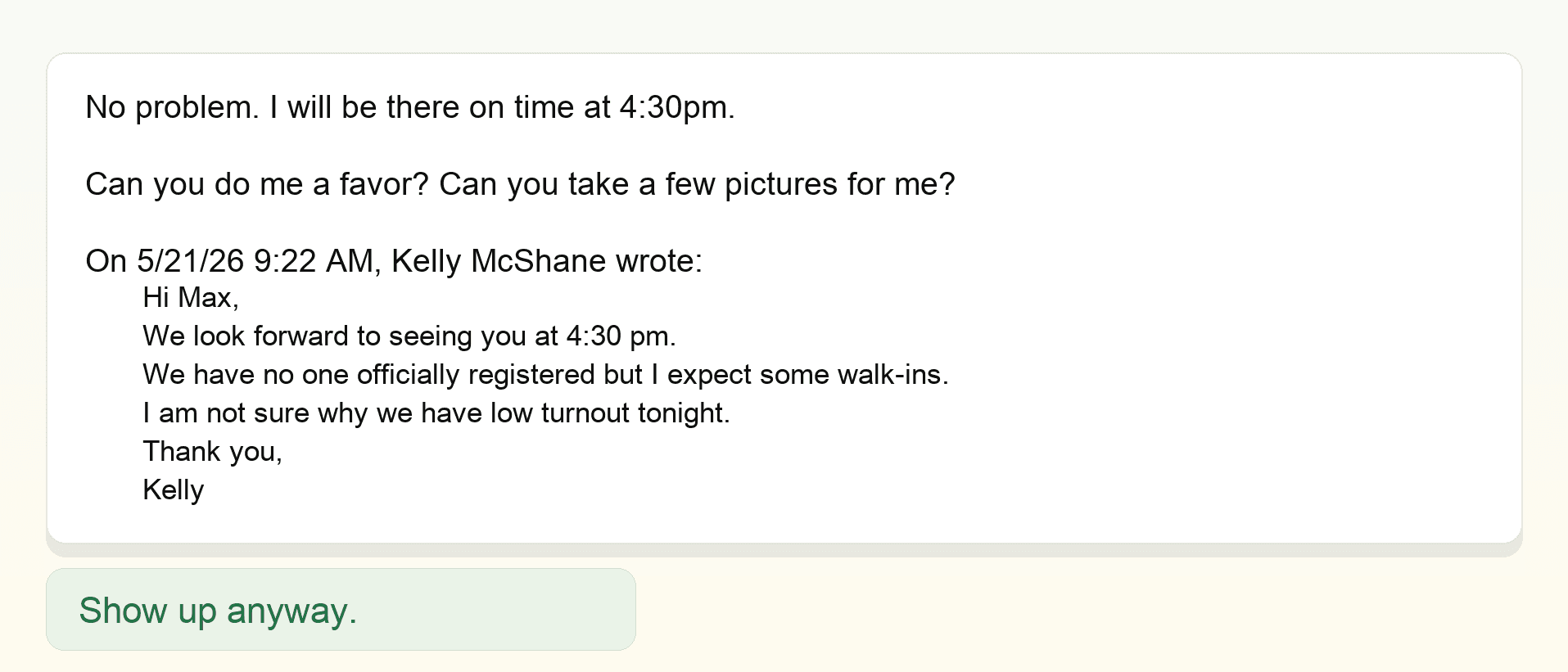
Kelly, the assistant director of the Andover Senior Center, has been wonderful to work with. I have a very good working relationship with her. She is kind, professional, and practical. So when she emailed me that morning and said, "We have no one officially registered but I expect some walk-ins," I knew she was not trying to discourage me. She was simply telling me the truth.
Still, that sentence landed hard.
I had a choice to make. Should I cancel the talk, or should I risk the humiliating defeat that no one would show up?
The Empty Room in My Imagination
Before the event even started, I could already imagine the empty room. I could imagine setting up my slides, looking at the chairs, checking the time, and realizing that the talk had become a private meeting with myself.
That is not a pleasant picture. Anyone who speaks in public knows this feeling. The fear is not only that the event will be small. The fear is that the small number will say something about you, your topic, your work, or your future.
My guess is that my topic was probably too narrow. The latest AI development is a useful subject, but "OpenAI as an Example of Autonomous AI Agent" may not sound immediately interesting to many seniors. Maybe a broader title would have helped. Maybe a more practical title would have helped. That is a lesson for me.
But in that moment, the real question was much simpler: will I still show up?
Hope Is a Practical Skill
Hope can sound like a soft word, but for a small business owner, a speaker, or anyone trying to build something, hope is very practical. Hope is what lets you prepare when you are not sure anyone will care. Hope is what lets you leave the house when canceling would feel safer.
So I replied that there was no problem. I would be there on time at 4:30pm. I also asked Kelly if she could take a few pictures for me.
That small reply mattered to me. It was a way of saying: I am still going to treat this as a real event. I am still going to prepare. I am still going to respect whoever walks in, even if the number is small.
Sometimes persistence starts before the room fills. It starts when you decide the room is still worth entering.
Twelve People Came
In the end, twelve people attended the talk.
That is not a great number. At a better event, we may have 30 to 40 participants. Twelve is not the kind of number people usually brag about.
But after hearing that no one had officially registered, twelve felt very different. Twelve was a room. Twelve was a conversation. Twelve was a real audience. Twelve was a reason to be grateful.
And more importantly, twelve people meant the choice to show up was the right choice. If I had canceled, I would have turned a small event into no event. By showing up, I gave the event a chance to become something.
The Lesson I Needed
The moral lesson is simple: persistence is super important.
Not dramatic persistence. Not heroic persistence. Just the ordinary kind: answer the email, go to the event, bring the slides, respect the audience, and keep learning.
I also learned something about communication. If I want people to come to an AI talk, I need to make the topic feel useful before it sounds technical. Maybe the next title should focus less on the internal structure of AI agents and more on what people can actually do with AI in daily life.
But I am glad I went. I am grateful to Kelly. I am grateful for the twelve people who came. And I am reminded again that hope is not just a feeling. Sometimes hope is a calendar appointment you keep even when the registration list looks empty.

Max Li
Founder, Grassrootech
max@grassrootech.comMax is dedicated to bridging the gap between advanced research and practical industry application. Drawing on his experience at IBM Research and Union University, he leads the development of AI solutions that drive meaningful progress.
Read More

What Should You Do If You Have Used Up Your Quota for OpenAI Codex?
OpenAI Codex is excellent, but quota limits are real. Here is a practical fallback strategy for developers who want to keep building without jumping immediately to a more expensive plan.

Have you heard of OPC: One Person Company?
AI is making a new kind of company imaginable: one person coordinating agents, software, and distribution with the leverage of a much larger team.