SpaceX Goes Public — Is Elon Musk Overrated?
SpaceX is going public—and it is doing so at a valuation that, on paper, looks absurd. That revives an argument my friends never seem to settle: is Elon Musk a once-in-a-century genius, or the most overrated man in tech?
A valuation that “absolutely does not” make sense
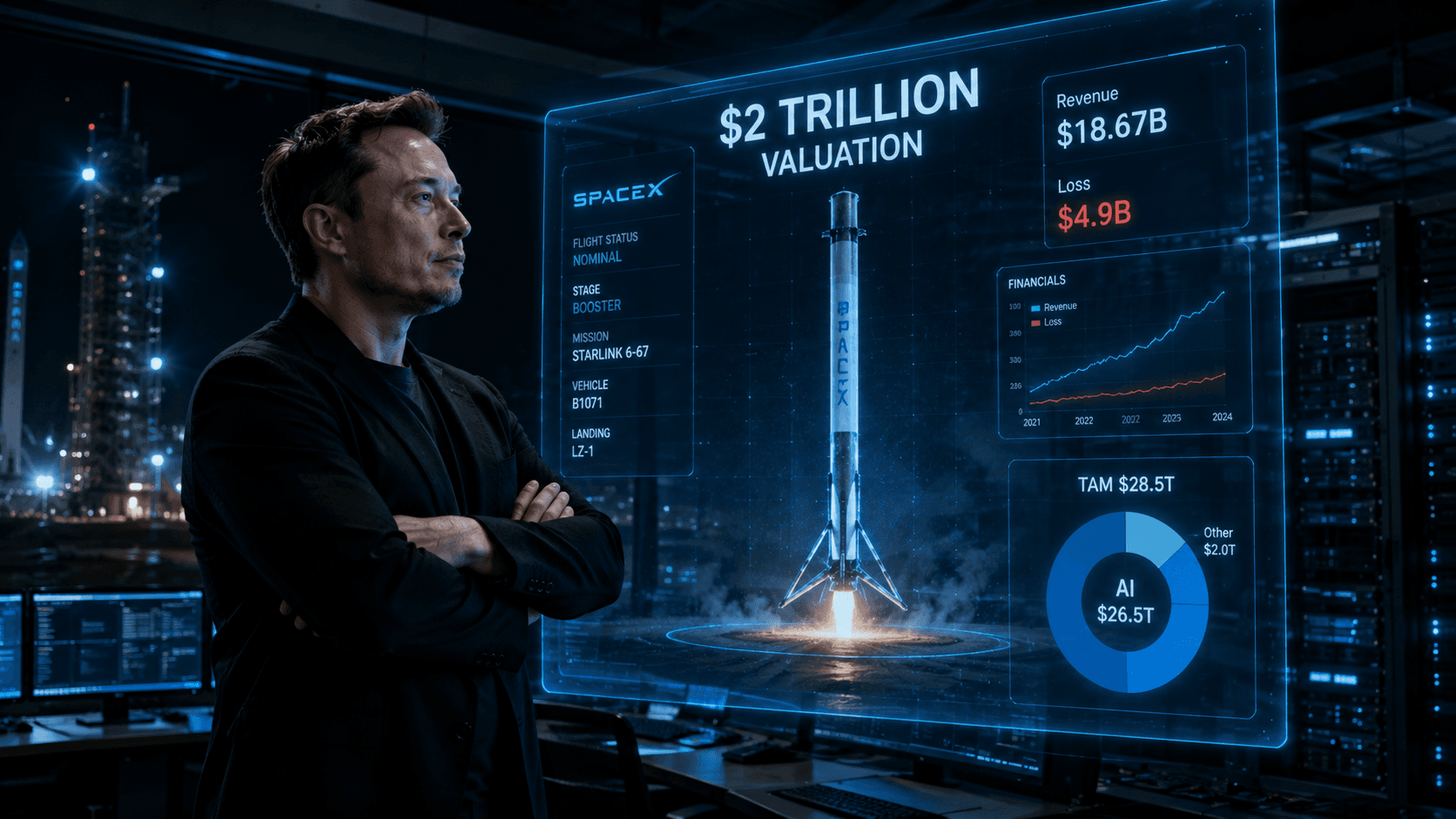
Start with the numbers, because they are startling. In his analysis of the SpaceX IPO, Ben Thompson of Stratechery notes that the company is seeking a $2 trillion valuation on $18.67 billion in revenue while losing $4.9 billion. By normal financial logic, Thompson writes, the numbers “absolutely do not” add up. SpaceX's own deck claims a $28.5 trillion total addressable market, with a staggering $26.5 trillion attributed to AI—more than 13 times the size of space and connectivity combined.
So why take the valuation seriously? Because the pitch is not really about today's rockets. It is about where Musk thinks the world is going.
The secret: data centers in space
The most provocative idea in Thompson's piece is “data centers in space.” As AI demand explodes, building data centers on the ground is running into hard limits: power shortages, zoning fights, and community opposition. Musk's answer is to move compute off the planet.
Picture each satellite as a computing rack. A Starlink V2 satellite is roughly large enough to hold a GPU cluster comparable to Nvidia's NVL72, with fleets of satellites interconnected by lasers. Modern agentic AI workloads can tolerate some latency, so slower, cheaper, solar-powered compute in orbit could become viable. Science fiction begins to look like an answer to a very real terrestrial bottleneck.
That is the secret behind the valuation. SpaceX is not being priced merely as a launch company; it is being priced as a possible infrastructure layer for space-based AI, with reusable rockets and Starlink as the on-ramp.
Musk's method: work backward from the impossible
Thompson describes Musk's playbook as a series of all-in bets: start with the desired outcome—Mars, full autonomy, virtually unlimited compute—and work backward to the steps required to get there. His companies, and their stock, become a way for other people to buy into those dreams.
This is why the IPO matters beyond finance. It offers ordinary investors a stake in an audacious venture and returns the IPO to its original purpose: financing a risky vision of the future. It is also why judging Musk only by this quarter's balance sheet can miss the larger strategy.
Why the believers are not crazy
Whatever you think of Musk himself, his track record is difficult to wave away. Tesla pushed the global auto industry toward electric vehicles. China's booming EV sector, in particular, accelerated under the “catfish effect” created by Tesla's arrival: one aggressive competitor forced everyone else to move faster.
SpaceX and Starlink are two more monumental innovations. SpaceX's rocket-recovery program dramatically reduced the cost of reaching orbit, and those cheaper launches allowed the Starlink network to mature. The result is internet connectivity from airplanes at cruising altitude, ships in the middle of the ocean, and remote regions poorly served by terrestrial infrastructure.
Musk proposes things that sound insane—right up until they work.
Madman or messiah?
The people around me hold sharply divided opinions. Some see a madman, though even they acknowledge his genius and vision. Others admire him almost as a deity, thrilled by his plans to colonize Mars. Both camps are reacting to the same trait: Musk proposes things that sound impossible right up until they begin to work.
That is the honest tension inside the “overrated” question. Many of his plans look audacious in isolation. Viewed as steps within one grand vision—cheaper launches enabling Starlink, Starlink enabling orbital compute, and all of it funding the road to Mars—the audacity begins to look like strategy. Only as each step becomes real do we grasp the world-changing ideas inside the larger plan.
So, is he overrated?
My verdict is no—but he is frequently misread. Musk is not overrated on impact: electric vehicles, cheaper launches, and global satellite connectivity are real and already here. Skepticism is fair when it comes to timelines and hype. He sells the destination while the world judges him at the current mile marker.
Buying SpaceX stock would not simply mean buying $18.67 billion of revenue. It would mean betting that one man can keep turning improbable ideas into infrastructure. He has done it enough times that dismissing the vision outright is difficult. Overrated is the wrong word. Unfinished is the right one.
Source
Tom Zhang
Contributor, Grassrootech
Tom Zhang writes about artificial intelligence, technology, and innovation.

Max Li
Founder, Grassrootech
max@grassrootech.comMax is dedicated to bridging the gap between advanced research and practical industry application. Drawing on his experience at IBM Research and Union University, he leads the development of AI solutions that drive meaningful progress.
Read More
What Should You Do If You Have Used Up Your Quota for OpenAI Codex?
OpenAI Codex is excellent, but quota limits are real. Here is a practical fallback strategy for developers who want to keep building without jumping immediately to a more expensive plan.
Have you heard of OPC: One Person Company?
AI is making a new kind of company imaginable: one person coordinating agents, software, and distribution with the leverage of a much larger team.