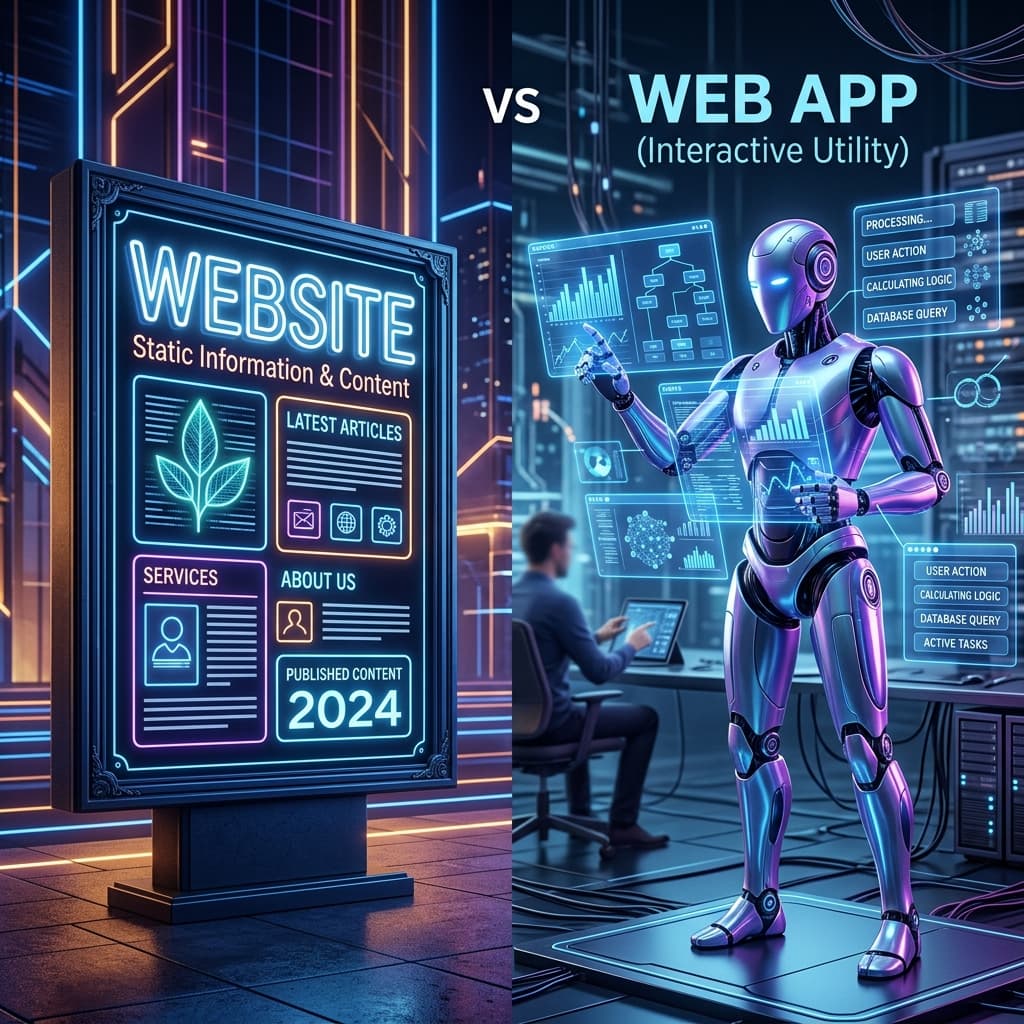
Website vs Web App: Are You Buying a Sign… or Hiring an Employee?

If you're looking to build an online presence, you'll hear two terms constantly: "website" and "web app." In casual conversation, people use them interchangeably. But in practice, they represent two completely different approaches to technology.
To understand the difference, think of your business as a physical storefront. A website is your sign; a web app is your employee.
The Website: The Digital Sign
A website’s primary job is to display information. It’s like a high-end marketing brochure or an illuminated sign outside your shop. Its goal is to tell people who you are, what you do, and how they can contact you.
Websites are generally static. While they might have beautiful animations or rotating images, the core content remains the same for every visitor. When you visit a typical law firm's site or a local restaurant’s page, you are viewing a "website." It provides information, but it doesn't "do" work for you.
Take blog.samaltman.com as an example. Sam Altman is the CEO of OpenAI, one of the most technologically advanced companies in the world. Yet, his blog is extremely basic—some might even say "lousy" by modern design standards. Why? Because it’s a pure website. Its only job is to host text, and a few pictures. It doesn't need data processing, user accounts, or complex logic.
The Web App: The Digital Employee
A web app is an interactive utility. It doesn’t just show you things; it does things. A web app is designed to process data, perform logic, and help the user (or the business owner) complete a specific task.
Think of an employee. You don't just look at an employee to get information; you interact with them to get a result. A web app might handle bookings, manage inventory, calculate complex prices, or facilitate transactions.
Amazon.com is the perfect example. Is it a website? Technically, yes, in the same way that a high-speed train is technically a "vehicle." But in reality, it is a massive web application. It tracks your shopping history, processes payments, manages millions of inventory items in real-time, and provides personalized recommendations. It is a digital engine that powers e-commerce activity.
Why the Distinction Matters
Many clients come to us asking for a "simple website," but what they actually need is an "employee"—a system that automates their intake, filters their leads, or handles their payments. Conversely, some attempt to build complex applications when a high-quality "sign" (a focused landing page) would be more effective for their stage of growth.
The Summary:
Websites
For displaying static information.
Web Apps
For processing dynamic information.
Are you looking to build a better sign for your business, or are you ready to hire your first digital employee? The answer defines your entire technology strategy.

Max Li
Founder, Grassrootech
max@grassrootech.comMax is dedicated to bridging the gap between advanced research and practical industry application. Drawing on his experience at IBM Research and Union University, he leads the development of AI solutions that drive meaningful progress.
Read More

What Should You Do If You Have Used Up Your Quota for OpenAI Codex?
OpenAI Codex is excellent, but quota limits are real. Here is a practical fallback strategy for developers who want to keep building without jumping immediately to a more expensive plan.

Have you heard of OPC: One Person Company?
AI is making a new kind of company imaginable: one person coordinating agents, software, and distribution with the leverage of a much larger team.